
Reformer Pilates for Men: Why Are Strength Athletes Turning to the Reformer?
For men, reformer Pilates provides mobility, core control and injury prevention as a complement to strength training. We explain why strength athletes are turning to the reformer.
Until a few years ago it was rare to see an athlete who had spent years squatting, deadlifting and bench pressing in the weights room step into a reformer studio; today reformer Pilates for men is increasingly the choice of serious strength athletes in particular. In this article we look at the reasons behind that change, how the reformer contributes to strength training and the questions men ask most often.
Where does the perception of a “women's sport” come from?
The perception that Pilates appeals to a largely female audience stems from the fact that group classes tend to have more female participants; the Joseph Pilates method, however, was originally developed for male boxers and dancers. The reformer itself is a resistance and movement tool that makes no distinction by sex; the springs can be reset to be heavier according to an athlete's current strength. The perception that “the reformer is light exercise” therefore does not reflect the machine's real capacity.
The common problems strength athletes face
- Limited shoulder and hip mobility: Repetitive movement patterns under heavy load can create stiffness at certain joint angles.
- Weak deep core control: Even if the visible abdominal muscles are strong, deep core stabilisation (transversus abdominis, multifidus) may be underdeveloped.
- An asymmetrical distribution of strength: Favouring a dominant side can create a difference between the two sides, which increases the risk of one-sided injury.
- A lack of eccentric control: While concentric strength (the lifting phase) is often the priority in weight training, the controlled lowering (eccentric) phase can be neglected.
The reformer is a tool that addresses all four of these areas directly.
The benefits the reformer offers strength athletes
1. Gaining mobility under load
Reformer movements do not merely stretch the muscles but also work them in a controlled way against spring resistance (loaded stretching). This is a method of gaining mobility that athletes take to more readily than static stretching and that is considered more lasting.
2. Deep core stabilisation
In movements such as the squat and deadlift, what really protects the spine is not the visible abdominal muscles but the deep core cylinder. By working that cylinder in a targeted way, the reformer supports spinal safety during heavy lifting.
3. Detecting and correcting asymmetry
Single-sided reformer movements clearly reveal differences in strength and control between the two sides. The trainer can observe that difference and give extra focus to the weaker side.
4. Eccentric control
Releasing the platform slowly and under control against the force of the spring pulling the carriage back works eccentric muscular control directly, and that is a critical skill in injury prevention.
5. Active recovery
Between heavy training days, moderate-intensity reformer sessions with low joint load can be used as active rest days that support recovery by increasing blood flow.
The standout benefits by sport
| Sport | The reformer's contribution |
|---|---|
| Weightlifting / powerlifting | Hip and shoulder mobility, core stabilisation, correcting asymmetry |
| Running | Hip extensor strength, single-leg stabilisation, flexibility |
| Golf / tennis / padel | Rotational power, anti-rotation core control, shoulder health |
| Combat sports | Hip mobility, the core-hip connection, balance |
An example weekly combination
For an athlete continuing with strength training, a typical week might be built as follows:
- Monday: Heavy lower-body strength training (squats, deadlifts)
- Tuesday: Reformer Pilates (mobility- and core-focused, low to moderate intensity)
- Wednesday: Heavy upper-body strength training
- Thursday: Reformer Pilates or mobility & stretching
- Friday: Functional/full-body strength training
- Weekend: Active recovery, gentle swimming in the indoor pool
This programme can be personalised according to your goals and your current training volume, along with the examples on our weekly schedule it can be customised together with the examples on our page.
A change in breathing technique: from Valsalva to diaphragmatic breathing
Most athletes in weight training use the Valsalva manoeuvre, holding the breath to increase intra-abdominal pressure during heavy lifts; that technique is useful for producing maximal force. However, when that habit is carried over into everyday life and low to moderate intensity movement, it can lead to unnecessary tension and a shallow breathing pattern. Reformer sessions teach athletes to synchronise the breath with movement and to achieve core stabilisation without holding the breath where appropriate; the two techniques are not mutually exclusive, and you learn to use them in the right context.
Shoulder health and the bench press
In athletes who regularly bench press and do similar pushing movements, the chest muscles can shorten while the upper back muscles (particularly the middle and lower trapezius and the rhomboids) become relatively weak. That imbalance can increase the risk of shoulder impingement. Pulling movements with the straps on the reformer target precisely that weakened muscle group and restore the push-pull balance. Balance work like this can be seen as a preventive investment for athletes continuing with heavy bench press programmes.
Hip mobility and squat depth
One of the most common reasons squat depth is limited is inadequate hip joint mobility (particularly hip flexion and internal/external rotation). Hip-opening movements performed kneeling and side-lying on the reformer develop that mobility under load and in a controlled way. Some athletes report getting into deeper squat positions more comfortably after a few weeks of regular reformer work; this is an individual observation and may not happen at the same rate for everyone.
Common mistakes
- Underestimating the reformer: Leaving the springs at their lightest setting and performing movements superficially means not using the machine's real potential.
- Trying only to show off your strength: The aim in reformer movements is not to lift weight but to demonstrate control; moving fast and without control reduces the benefit.
- Not integrating the core with the breath: Carrying the “Valsalva” style breath-holding habit learned in the weights room over to the reformer undermines the purpose of the movement.
- Skipping the mobility work: Trying to repeat only strength movements on the reformer and ignoring the flexibility element means missing the machine's greatest advantage.
Who it is not suitable for / who should approach it carefully
- For athletes with an acute muscle or joint injury, an assessment by a sports physiotherapist is recommended before starting a reformer programme.
- In those with a history of shoulder instability, some strap movements should be modified with the approval of a doctor or physiotherapist.
- In athletes close to a serious competitive season, reformer intensity should be set carefully so as not to tire them for their main training.
How is progress measured?
In strength athletes, progress on the reformer is usually assessed by its indirect contribution to performance in their main training: indicators such as increased squat depth, less discomfort in overhead movements and the closing of the strength gap between the two sides are tracked. Within the reformer itself, being able to increase spring resistance gradually while maintaining movement control is monitored.
An example case
When an athlete who powerlifts regularly comes to us complaining of stiffness in the right hip and mild asymmetry during squats, the programme usually progresses as follows: the first two weeks focus on hip mobility and core awareness; from the third week, single-sided footwork and anti-rotation work are added; in the fifth week, movements focused on eccentric control come in. By the end of the sixth week the athlete reports increased squat depth and less stiffness in the hip.
Group class or one-to-one?
Both group and one-to-one formats have advantages for strength athletes. Group classes provide social motivation and the discipline of a regular schedule, while one-to-one sessions allow a specific asymmetry or restriction to be worked on in a targeted way. Many athletes prefer to spend the first few weeks building a foundation one-to-one and then move on to small-group classes. For detailed group class options, see group classes page.
Feedback from other male athlete profiles
Runners generally describe their improvements in hip extensor strength and single-leg stability as feeling less fatigue on long runs. Combat athletes describe a stronger hip-core connection as feeling that their punching and kicking power comes from a more stable base. Observations like these are individual and cannot be presented as a generalised conclusion; but they do give an idea of why the reformer is the choice of athletes across different sports.
Equipment and technical details
When working with strength athletes, trainers usually start with medium-to-heavy springs and increase the resistance gradually as long as movement quality holds. Short loops are preferred for single-sided work and long loops for symmetrical arm series. Footbar height is an important variable in hip mobility movements.
The link with the reformer basics
To learn more about how the reformer works, how it differs from mat Pilates and the six core Pilates principles, you can read our What Is Reformer Pilates? article. For strength athletes, the reformer is a performance-oriented extension of those core principles.
The reformer for strength athletes at O’Wellness Sky
In our Reformer Pilates Our studio has 8 Balanced Body reformers; our strength athletes usually integrate mobility and core programmes into their main training through one-to-one or small-group sessions. Anyone wanting to combine strength training in our Athletic Performance studio with the reformer can look at the personal training options on our special services page. For our team of trainers, take a look at the trainers page.
Frequently asked questions
Does reformer Pilates make you lose muscle mass?
No - the reformer works on endurance and control under low to moderate load; it does not cause muscle loss. It should be thought of as a tool that complements your main strength training rather than replacing it.
How many reformer sessions a week can someone doing strength training add?
Usually 1-2 sessions a week, placed between your main strength workouts, is enough. The intensity is set with your trainer according to your recovery capacity.
Is the reformer useful for returning to strength training after an injury?
Yes - thanks to its low joint load and adjustable resistance, the reformer is often the choice for gradual loading after an injury. We recommend progressing in coordination with your sports physiotherapist.
Why choose O’Wellness Sky for reformer Pilates for strength athletes in Sarıyer?
Located under the same roof as the Athletic Performance studio, our Reformer studio offers an integrated programme supporting your strength training, with certified trainers and sports physiotherapist support.
Realistic expectations when starting out
Strength athletes new to the reformer can find the first few sessions unexpectedly hard; this is not because of a lack of muscular strength but because their neuromuscular coordination has not yet developed for the unfamiliar demands of control and stabilisation. That is a natural learning curve and gets markedly easier within a few weeks.
The common comment from many strength athletes who have tried the reformer is that, contrary to first impressions, the machine is anything but “easy”; the real difference lies in the type of strength used, the speed of movement and the level of control required.
For a reformer Pilates programme to complement your strength training, enquiry form fill in the form and let's plan a first assessment session that suits you.
Related posts

Reformer Pilates close to Maslak and Ayazağa: the studio experience at Skyland Istanbul
The location, session flow and membership options of the O'Wellness Sky studio in Skyland Istanbul for employees looking for reformer Pilates in Maslak.
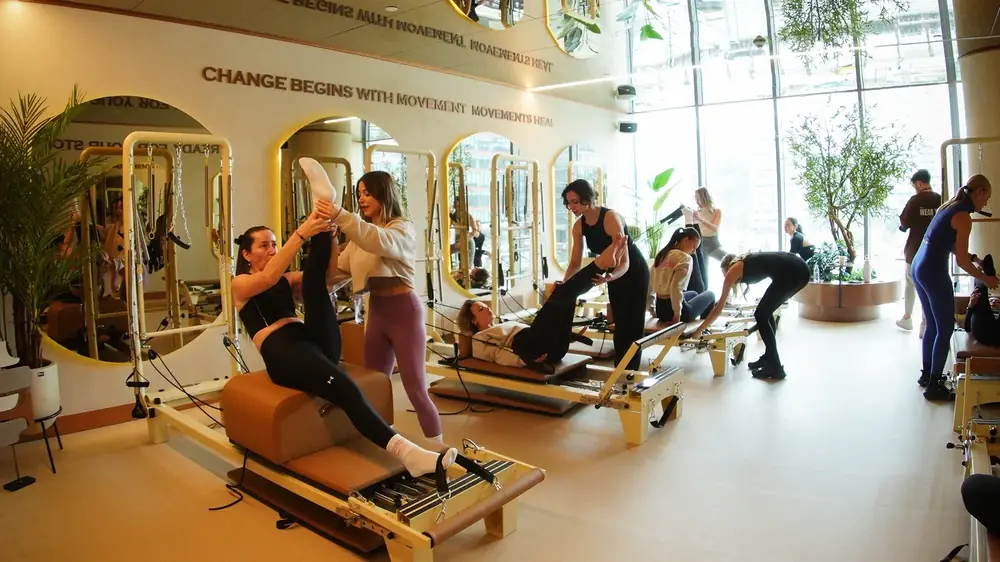
One-to-One Reformer Pilates or a Group Class? The Right Format for Your Goal
We compare the differences between one-to-one reformer Pilates and group classes, which format suits which goal and the cost-benefit balance, with examples from Skyland Istanbul.
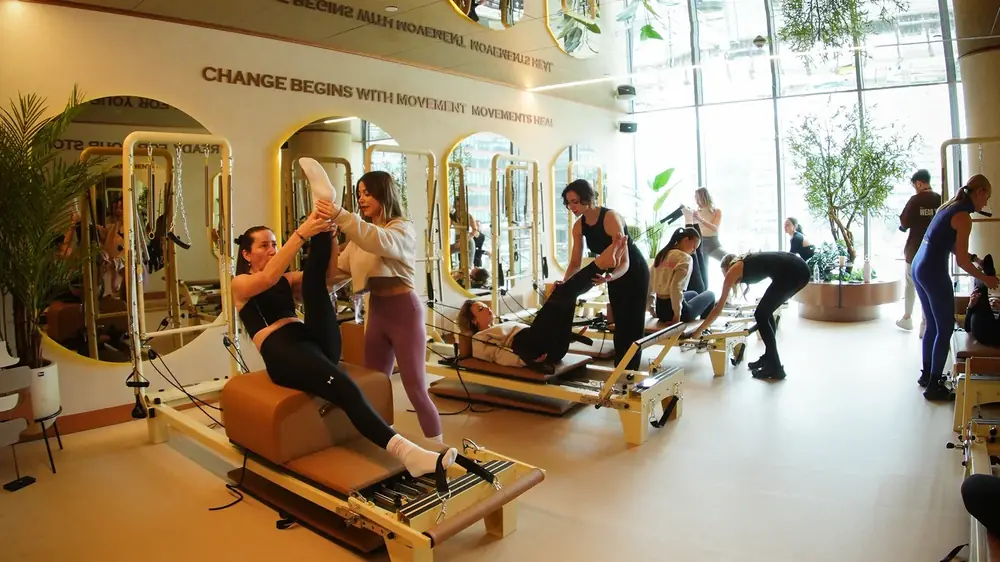
A Glossary of Reformer Pilates Terms: Footwork, the Hundred, Long Stretch and More
A comprehensive glossary covering the meanings of terms you will often hear in a reformer Pilates class, such as footwork, the hundred and long stretch, which muscles they work and tips for performing them correctly.
