
One-to-One Reformer Pilates or a Group Class? The Right Format for Your Goal
We compare the differences between one-to-one reformer Pilates and group classes, which format suits which goal and the cost-benefit balance, with examples from Skyland Istanbul.
When you decide to start Reformer Pilates, the first question you face is usually about format: one-on-one or group class? This is not a question with a right or wrong answer; it is a decision that depends on your goal, your budget, your past experience and your personal preference. To find the right answer, you first need to understand clearly what each format actually offers and how they differ. In this article, we look at the concrete differences between one-on-one Reformer Pilates and group classes, which format suits which kind of person, and how the two formats can be used together.
The key differences between the two formats
| Criterion | One-to-one | Group lessons |
|---|---|---|
| Charged separately per session, high | 100% personalized program | Based on the general level, limited individual modification |
| Instructor attention | Continuous, without a break | Shared among 6-8 people |
| Flexibility (hours) | Usually more flexible appointment times | Flexibility |
| Social motivation | Low | High; group energy can be motivating |
| Personal training | Higher per session | More affordable per session |
| Learning speed | Usually faster, corrections are immediate | More gradual, learning by observation |
Who is one-on-one reformer pilates suitable for?
- Those with a complex health history: People with a history of a herniated disc, a period after shoulder surgery or chronic pain need movements to be adapted to them immediately and completely.
- Those pregnant or in the postpartum period: Requires modifications specific to the trimester or the postpartum recovery period.
- Beginners who want to progress quickly: One-on-one sessions are an advantage for those who want to learn the basic movement vocabulary quickly and correctly.
- Athletes with a specific performance goal: Situations in sports such as golf, tennis or running that call for a personalized analysis of asymmetries and weaknesses.
- Those who want to schedule their program flexibly around a busy work pace: Those who have difficulty keeping to fixed group times.
Who is the group class suitable for?
- Those with general health and fitness goals: For people without a specific health restriction who are looking for general strength and flexibility, group classes are sufficient and effective.
- Those who need social motivation: Group energy can make it easier to keep attending regularly.
- Those planning around a budget: For those who want to build a regular, long-term habit, group classes are more affordable per session.
- Those who have already learned the basic movement vocabulary: Starting one-on-one and moving to the group format after the basic alignment is established is a common and effective path.
A hybrid approach: combining the two
Many of our members actually choose neither “only one-on-one” nor “only group”; they combine the two. For example, taking a one-on-one assessment session once a month and continuing the remaining sessions in the group format keeps the cost reasonable while also providing regular personalized feedback. If a new movement is to be learned or you are returning after an injury, starting with a one-on-one session and joining the group class once your form is established is also a frequently preferred path.
An often-overlooked advantage of one-on-one: speed
One of the most concrete benefits of one-on-one sessions is the speed of learning. In a group class, the instructor has to pay attention to 6-8 people at the same time, whereas in one-on-one, every correction is made instantly and directly. This makes it possible to establish correct alignment in a much shorter time, especially in complex movements (such as long stretch and short box), and allows faulty patterns to be corrected early, before they become ingrained. This speed advantage, which is valued over time, is the main factor that justifies the higher session price of one-on-one for some members.
An often-overlooked advantage of group classes: learning by observation
In group classes, watching other participants can be an unexpected source of learning for some members. Seeing a movement on different body types, with different modifications, can increase your awareness of your own body. In addition, the mild competition and sense of solidarity that a group setting brings provide higher motivation for some people than working individually; seeing familiar faces in a group class you attend regularly is an important factor supporting long-term consistency.
The cost of choosing the wrong format
Choosing the wrong format usually shows up in two ways: joining a crowded group right away with a complex health history and not getting the individual attention you need, or continuing with unnecessarily expensive one-on-one sessions for a simple general fitness goal. In both cases, reviewing your format decision at regular intervals (for example, every 2-3 months) helps you optimize both your budget and your results.
Questions to ask when deciding
- Is my health history complex? If so, starting one-on-one is recommended.
- How flexible is my budget per session? If it is limited, a group class or a hybrid model can be considered.
- Do I work better in a social setting or in a quiet, focused one? This determines your source of motivation.
- Do I have a specific performance or rehabilitation goal? If so, one-on-one may be more suitable for a personalized program.
- Do I need to plan my program around fixed times or flexible times? If flexibility matters, the one-on-one appointment system is an advantage.
How to balance cost and benefit
Although one-on-one sessions cost more per session, faster learning and a lower risk of injury can reduce the risk of “lost sessions” in the long run. Group classes, on the other hand, are generally a more accessible option for a regular, sustainable habit. When deciding, it is recommended to look not only at the session price but also at how quickly you reach your goal and your overall satisfaction; sometimes the option that looks more expensive can actually turn out to be more economical because it gets you to the goal sooner.
The transition: from one-on-one to group, from group to one-on-one
When moving from one-on-one to a group class, it helps to get a short briefing from your instructor on the pace and overall flow of the group format. When moving from a group to one-on-one, there is usually a specific goal to focus on (returning from an injury, clarifying a movement, a performance goal); these transitions can be made flexibly at any time, depending on your membership type, and talking with your instructor about such a transition in advance makes it easier to define the goal clearly.
An example case
The process for a member with a history of a herniated disc who has never done Pilates before usually goes like this: the first session is held one-on-one, and the physician's report and the movements that trigger pain are assessed. For the first 6-8 weeks, again one-on-one, a program focused on a neutral spine and without flexion is applied. As the pain-free range of motion widens and the basic movement vocabulary settles, the member can move to small-group (duo or 4-person) classes. This transition decision always depends on the instructor's observation and on the member feeling ready; there is no fixed timeline. This example shows how the move from one-on-one to group can be managed gradually and safely.
Practical ways for beginners to reduce cost
- Buying a package: Buying a package instead of single sessions usually lowers the cost per session.
- Starting one-on-one and moving to group: Taking the first few sessions one-on-one and, once the basic movement vocabulary is established, moving to more affordable group classes balances both safety and budget.
- Using the duo format: By joining with a spouse, friend or family member, you can get near one-on-one attention at a shared cost.
- Reviewing membership packages: A Fitness + Reformer membership can optimize overall cost by providing access to both group classes and the Reformer package.
Why does trainer-member fit matter?
As much as the choice of format, who you work with also shapes your experience. In the one-on-one format this fit matters even more, because the entire session is spent with that instructor. If an instructor's communication style, way of giving feedback or preferred pace does not match yours, do not hesitate to take a trial session with a different instructor; as in many studios, here too this is met as a completely normal and supported request.
How to get more individual attention in a group class
Even if you choose a group class, there are ways to get individual attention: joining classes with small group sizes (for example, groups of at most 6-8 people), arriving early to the class for a short chat with the instructor, and working regularly with the same instructor so that over time the instructor gets to know your movement patterns. Although this does not give the group format all the advantages of one-on-one, it can significantly increase the level of personalization.
The duo (2-person) format: a middle option
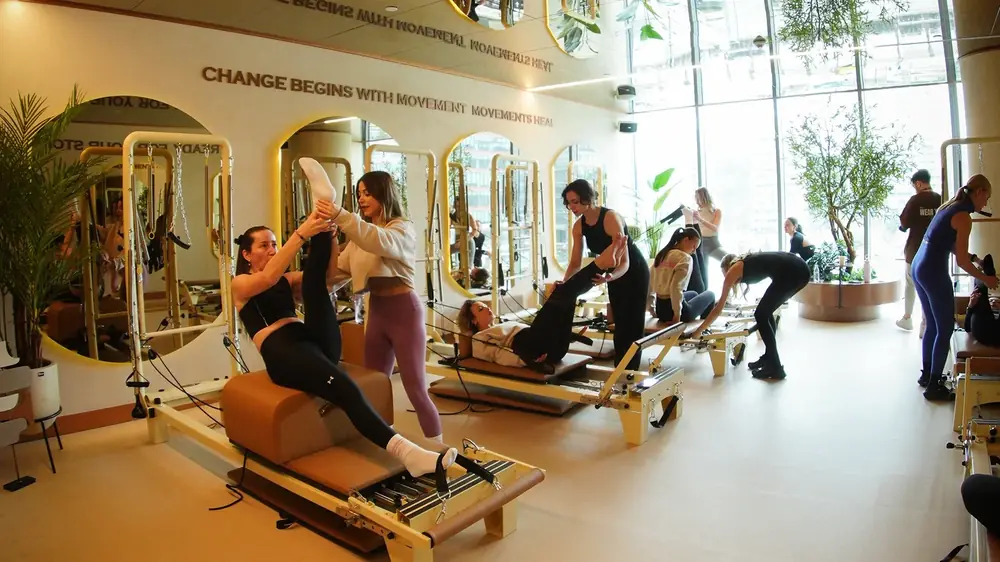
As in some studios, a duo format is available at O’Wellness Sky as well; it lets two people (for example, a spouse, friend or family member) work with the same instructor with near one-on-one attention but at a shared cost. For two people with similar goals, this can offer a balanced middle path between one-on-one and a group class; it is a practical solution, both socially and budget-wise, especially for spouses or close friends.
Choosing a format at O’Wellness Sky
In our Reformer Pilates studio offers group, duo and one-on-one formats. Our recommendation for new members is to take the first session as a one-on-one assessment; this way, the instructor can learn your health history and goals and recommend the most suitable format for you. For those aiming for general strength and flexibility, complementary group classes such as Mat Pilates and Total Body can also be added to your program. For detailed information about membership options, you can visit our membership page, and for our team of trainers, our trainers page. The basic workings of the Reformer, What Is Reformer Pilates? guide.
Frequently asked questions
I have no Pilates experience at all; can I join a group class directly?
You can, but to learn the basic movement vocabulary faster and more safely, we recommend taking the first 1-2 sessions in the one-on-one format.
How much more expensive are one-on-one sessions than group classes?
The price difference is inherent to the nature of the format; for current pricing, you can reach us via enquiry form .
I have an injury; which format is safer?
In cases with a complex health history, the one-on-one format is considered safer because movements can be adapted immediately and fully to the individual.
Is there a Reformer studio in Sarıyer that offers both one-on-one and group classes?
Yes, at O’Wellness Sky Skyland Istanbul we offer all of the group, duo and one-on-one Reformer Pilates formats; there is easy access along the Maslak-Sarıyer corridor.
Can I change my format later?
Yes, depending on your membership, you can switch between one-on-one, duo and group formats, and even use two of them together; it is completely normal to reassess your format over time as your goals change.
To determine the right format for you, enquiry form fill in the form and make use of our free assessment session.
Related posts

Reformer Pilates close to Maslak and Ayazağa: the studio experience at Skyland Istanbul
The location, session flow and membership options of the O'Wellness Sky studio in Skyland Istanbul for employees looking for reformer Pilates in Maslak.
Reformer Pilates for Runners: Hip Stability and Injury Prevention
We look at the role of reformer Pilates for runners in hip stability, core control and preventing common running injuries, with examples of how it is applied in Skyland Istanbul.
Breathing in Reformer Pilates: Lateral Breathing and Syncing It with Movement
How lateral (side-rib) breathing works in a reformer pilates class, when to inhale and exhale, and the common mistakes.
