
Reformer Pilates in Pregnancy: A Guide to Safe Practice by Trimester
Reformer Pilates in pregnancy can be practised safely in all three trimesters with the right modifications. We explain the choice of movements by trimester, what to avoid and tips for getting ready.
The answer to the question “can I exercise while pregnant?” is mostly yes in an uncomplicated pregnancy, but the question of how matters. Reformer Pilates in pregnancy can be continued, modified appropriately in every trimester, thanks to the machine's adjustable support and wide range of movement. In this article we look at what to watch out for by trimester, which movements are preferred and which should be avoided.
General safety principles
Every pregnancy is different, so you need to get your obstetrician's approval before starting or continuing an exercise programme. The generally accepted principles are as follows:
- From the second trimester onwards, staying in the supine position for long periods is avoided; that position can carry a risk of the growing uterus compressing the main vein.
- Movements that excessively increase intra-abdominal pressure (intense abdominal crunches, holding the breath) are limited.
- High-difficulty single-leg movements that carry a risk of losing balance are avoided.
- Intense, non-stop sessions are avoided to prevent body temperature rising excessively.
- If there are signs of separation of the abdominal muscles (diastasis recti), movements are modified accordingly.
This general information is no substitute for medical advice; it is important to consult your doctor for guidance specific to your own health situation.
The approach by trimester
| Period | The main goal | What to watch out for |
|---|---|---|
| First trimester (0-13 weeks) | Maintaining current fitness, breathwork | If there is nausea, the intensity is reduced; overheating is avoided |
| Second trimester (14-27 weeks) | Postural support, hip and back strength | Long periods in the supine position are avoided; side-lying is preferred |
| Third trimester (28-40 weeks) | Pelvic floor awareness, breathing for birth preparation | Take care with changes in balance; the range of motion is reduced |
First trimester: maintaining the basics
If you did reformer Pilates regularly before pregnancy, you can continue with a routine similar to your existing one with your doctor's approval. Symptoms such as nausea and fatigue may naturally reduce the intensity; although there is no restriction specific to this period, listening to your body comes first. If you are just starting, it is appropriate to begin with basic footwork and breathwork on light springs.
Second trimester: posture- and hip-focused work
As the abdomen grows, the centre of gravity shifts forward and the lumbar curve can increase. In this period, hip and oblique work done side-lying on the reformer helps balance out the overloading of the back muscles. Supine movements are kept short or done with the upper body raised (supported with a cushion). In this period, trainers often prefer seated arm work with the straps, as it places no load on the back.
Third trimester: the pelvic floor and preparing for birth
In the final trimester, the focus shifts to pelvic floor awareness and the breathing techniques that will help during birth. Deep abdominal work gives way to gentle pelvic floor activation and lateral breathing. As changes in balance become more pronounced, standing movements are reduced and seated or side-lying work is preferred. Working one-to-one in this period makes it easier to adjust the movements to the individual in the moment.
Movements to avoid
- Prone movements that put pressure on the abdomen
- Prolonged, deep supine abdominal crunches (after the second trimester)
- Dynamic movements involving jumping or sudden changes of direction
- High-intensity core work done while holding the breath
The advantages of the reformer in pregnancy
The main reason reformer Pilates is the choice in pregnancy is that movements can easily be modified with the support of the straps and the platform. The same movement can be made safe by reducing the spring resistance or changing the position. The low joint load also prevents the ligaments, which loosen in pregnancy (under the effect of the hormone relaxin), being overstrained. For general information about the reformer, see What Is Reformer Pilates? article.
Common mistakes
- Insisting on your pre-pregnancy intensity: Continuing at the same weight and pace on the basis that “I was already exercising” can increase injury risk because of the changes in your joints.
- Carrying on with classic abdominal crunches: After the second trimester, deep abdominal crunches can increase the risk of diastasis; they should be modified.
- Going into a session dehydrated and hungry: Blood sugar swings can lead to dizziness faster in pregnancy; a light snack and water before the session matter.
- Holding your breath: Holding your breath, which increases intra-abdominal pressure, is a habit to avoid particularly in pregnancy.
- Not taking support in balance movements: Because of the shift in your centre of gravity, standing close to a barre or wall during standing balance work improves safety.
Who it is not suitable for / who should approach it carefully
- In pregnancies with a diagnosis such as placenta praevia, cervical insufficiency or pre-eclampsia, exercise can only be done with your doctor's specific approval and within their limits.
- In a multiple pregnancy (twins, triplets), the intensity and choice of movements should be determined more carefully with your doctor's advice.
- In pregnancies with a history of premature birth, a doctor's approval must be obtained before starting an exercise programme.
- People who have never exercised regularly should start not with an intense programme but at a very low intensity and for short periods during pregnancy.
How is progress tracked?
In pregnancy, “progress” is about comfort and function rather than increased strength: how tired you feel after a daily walk, how your lower back pain is developing, your sleep quality and how easily you are breathing are all asked about verbally by the trainer at the start of every session. The choice and duration of movements are adjusted in the moment on that basis; no fixed weekly target for increase is set.
An example session (second trimester)
- Welcome and check-in (5 min): How you are that day, your sleep, swelling and any pain are discussed.
- Breathing and a neutral pelvis (10 min): Diaphragmatic breathing in side-lying.
- Hips and obliques (15 min): Hip opening with the straps in side-lying, trunk stabilisation.
- Upper body and posture (10 min): Seated arm series, shoulder-opening movements.
- Relaxation (10 min): Gentle stretching and breathing in side-lying.
Session format and frequency
Reformer sessions in pregnancy are generally recommended in a one-to-one or duo format, 1-2 times a week. At O’Wellness Sky these sessions are planned under special services ; the trainer asks how you are that day (fatigue, pain, balance) before each session and adjusts the programme accordingly. Gentle stretching and a rest period are added after the session.
Choosing equipment and the studio environment
As sweating and sensitivity to heat can increase in pregnancy, a well-ventilated studio environment should be chosen. Our studios at O’Wellness Sky are checked regularly in this respect, and there is also somewhere to rest in the changing rooms before and after a session. Comfortable, breathable clothing and non-slip Pilates socks provide extra safety in this period of changing balance.
When to stop, and when to see your doctor
In cases of bleeding, regular contractions, dizziness, shortness of breath, chest pain or a marked reduction in the baby's movements, exercise should be stopped immediately and a doctor consulted. In high-risk pregnancies and conditions such as placenta praevia, an exercise programme should only be continued with a doctor's approval and within the limits they set.
Equipment and position adjustments
In reformer sessions in pregnancy, trainers add a cushion or support to the carriage to ease the pelvic angle, and can change the angle of the footbar to reduce hip flexion. In strap work, the long loop is generally preferred as it creates less shoulder tension. Accessories that press directly on the abdomen (heavy sandbags, for example) are avoided.
Combining it with related classes
Alongside reformer sessions, low-impact breathwork and flexibility work is a good complement in pregnancy. With your doctor's approval, easy-paced walking or classes such as yoga classes of this kind can be added; however, intense flow classes in a hot environment are generally best avoided during pregnancy.
A bridge to the postnatal period
Regular, safe reformer work maintained through pregnancy also lays positive foundations for postnatal recovery. For approaches specific to the postnatal period, as well as our guide , we cover pelvic floor and core recovery in detail in a separate article.
Why communicating with your trainer matters
The most critical element in progressing safely with reformer sessions in pregnancy is communicating openly with your trainer about how you are that day. If your sleep quality is poor, you feel nauseous or you notice a change in the baby's movements, telling your trainer before the session means the programme can be adapted in the moment. Energy levels can vary from day to day even within the same week, so a flexible approach is taken rather than sticking rigidly to a fixed weekly plan. Our trainers at O’Wellness Sky are experienced in working with pregnancy and have a brief check-in conversation before every session.
Balancing it with family and working life
For working pregnant women, planning 1-2 fixed sessions a week is the most practical way of maintaining continuity. Skyland Istanbul's proximity to the Maslak, Ayazağa and Levent corridor makes it easy to plan short sessions at lunchtime or after work. Allowing a short rest after the session helps with recovery, especially in the third trimester.
Frequently asked questions
When can you start reformer Pilates in pregnancy?
In an uncomplicated pregnancy, you can start from the first trimester with your doctor's approval. If you have no exercise background before pregnancy, starting in the second trimester at a low intensity is usually more comfortable.
Do you need to avoid supine movements altogether?
Short supine positions that cause no discomfort are generally not a problem; however, from the second trimester onwards, side-lying or a raised upper body is preferred over staying supine for long periods. If you feel discomfort or dizziness, change position immediately.
What should you do if you have diastasis recti (separation of the abdominal muscles)?
Modifications that gently activate the deep abdominal muscles without worsening the separation are used instead of classic abdominal crunches. Your trainer and, if necessary, your sports physiotherapist will give you specific guidance on this.
Why choose O’Wellness Sky for reformer Pilates in pregnancy in Sarıyer?
With one-to-one and duo session options, certified trainers and sports physiotherapist support under the same roof, our studio in Skyland Istanbul offers the right environment for running pregnancy-specific programmes safely.
The link with the reformer basics
To better understand the specific modifications of reformer Pilates in pregnancy, it helps to know how the machine works in principle. The logic of spring resistance, the movement of the carriage and the six core Pilates principles (centring, concentration, control, precision, breath, flow) apply in all sessions outside pregnancy too; you can find that basic information in our What Is Reformer Pilates? article. Your pregnancy programme is a specific adaptation built on that foundation.
For a reformer Pilates programme suited to your pregnancy, enquiry form fill in the form and let's plan a personalised assessment session.
Related posts
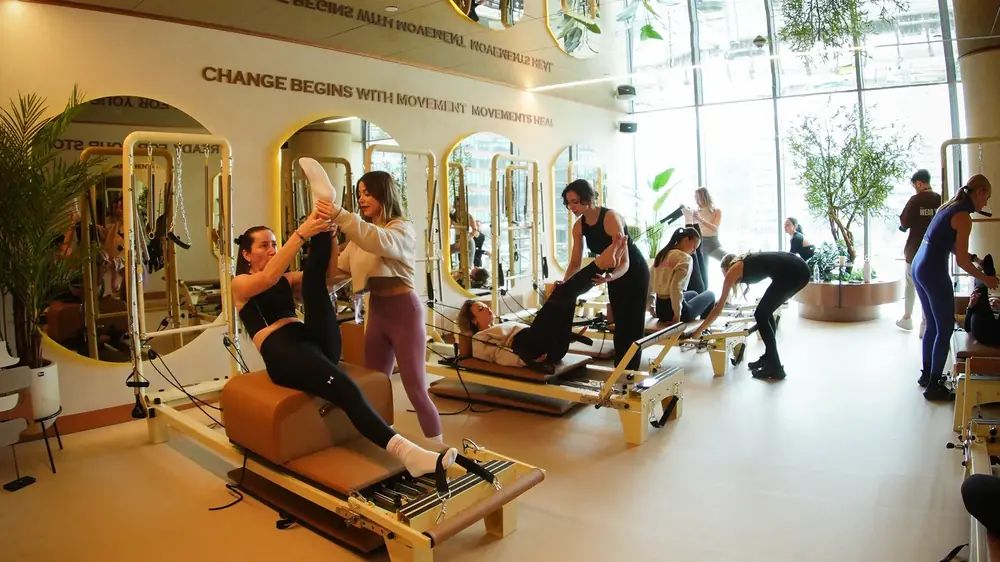
Reformer Pilates for Golf and Tennis Players: Rotational Power and Shoulder Health
How reformer Pilates contributes to rotational power, shoulder health and balancing asymmetry in sports involving one-sided rotation such as golf and tennis; explained through our work in Skyland Istanbul.

How Many Days a Week Should You Do Reformer Pilates? Programme Recommendations by Level
Concrete programme recommendations for beginner, intermediate and advanced levels on how many days a week to do reformer pilates, with tips on recovery, goals and weekly planning.
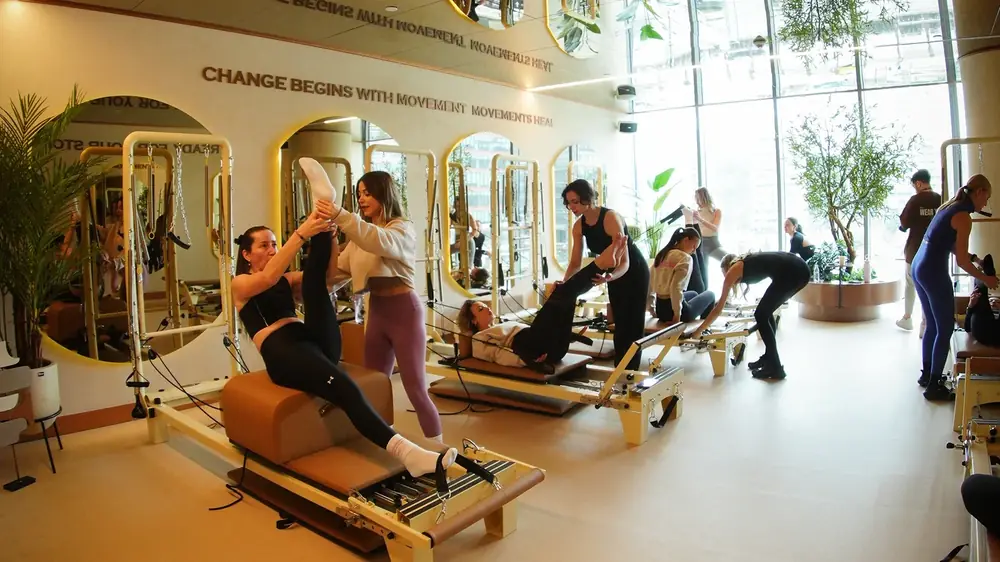
Reformer Pilates for Men: Why Are Strength Athletes Turning to the Reformer?
For men, reformer Pilates provides mobility, core control and injury prevention as a complement to strength training. We explain why strength athletes are turning to the reformer.
