
Meditation and Mindfulness: The Effect on Fitness Performance
How does meditation affect sporting performance? We explain its contribution to training in terms of breath awareness, mental focus and recovery, and practical ways to put it into practice.
The relationship between meditation and sports performance has in recent years become a subject of interest not only to athletes but to everyone who trains regularly. Mental focus and breath control are as important a part of performance as muscular strength and endurance. In this article we look at how meditation and mindfulness practices can contribute to training quality, recovery and motivation, and at how you can add those practices to your weekly programme.
What are meditation and mindfulness?
Meditation is a practice aiming to calm the mind by directing the attention to a particular object (usually the breath). Mindfulness, meanwhile, is the ability to observe what is happening in the moment without judgement; meditation is one of the ways of developing that ability. In a fitness context, those two concepts are used to read the body's signals better during training, to reduce unnecessary tension and to increase focus.
Mental focus and training quality
Having a scattered mental attention while lifting weights or controlling a movement on the reformer can make it harder for the movement to be carried out with the right muscle groups. It is generally observed that people who do regular breath and mindfulness work establish that focus - called the “mind-muscle connection” - more easily during movement. That connection directly affects the quality of the movement, particularly in disciplines requiring control such as Pilates and yoga.
The physiological effect of breathwork
Slow, deep diaphragmatic breathing is known to help reduce heart rate and muscle tension by sending a signal to the calming (parasympathetic) branch of the nervous system. A few minutes of breathwork before training supports starting the session more prepared by reducing unnecessary anxiety. After training, the same breathing technique can make the body's transition into recovery mode easier.
| The moment in training | The meditation/breath practice | The expected contribution |
|---|---|---|
| Before the session (3-5 min) | Diaphragmatic breathing, a short body scan | Focus, a reduction in unnecessary tension |
| During the session | Breathing synchronised with the movement | Movement control, the mind-muscle connection |
| After the session (5-10 min) | Slow breathing, a relaxation position | The nervous system calming, the transition to recovery |
| Rest days | 10-15 min of seated meditation | Stress management, sleep quality |
Step by step: a short mindfulness practice before a session
- Take a comfortable position (1 min): Seated or supine, shoulders relaxed.
- Body scan (1-2 min): From the feet up to the head, notice which areas are tight.
- Diaphragmatic breathing (2 min): Breathe in through the nose for a count of 4, out for 6; feel the abdomen expand with the breath.
- Setting an intention (30 sec): Briefly establish in your mind what you want to focus on in today's session.
- The transition: Open your eyes and start warming up with light movements.
The relationship between stress, cortisol and recovery
A chronically high level of stress can negatively affect sleep and overall recovery capacity, which can slow the progress expected from training. Regular meditation practice has been reported to reduce the perception of stress and to support the relaxation response. A mindfulness practice carried out alongside training can therefore contribute not only to mental but indirectly to physical recovery too. For the other components of the recovery process, recovery guide .
The role of yoga, budokon and breath-focused classes
Among the group classes at O’Wellness Sky, classes such as vinyasa yoga, budokon yoga and balanced yoga naturally include the practice of synchronising movement with the breath. Regular attendance at those classes is a practical way of developing mindfulness through movement for people with no experience of meditation. If you are looking for a calmer, slower-paced session, the mobility & stretching class also sets aside time for breathwork.
Common mistakes
- Ignoring the breath entirely: Holding your breath while lifting weights or during a challenging movement can raise intra-abdominal pressure unnecessarily and disrupts your focus.
- Seeing meditation only as “free time”: Even a short breathing break can contribute to the quality of your training; it should not be seen as a waste of time.
- Excessive expectations: Meditation does not create a dramatic jump in performance straight away; its effect accumulates over time with regular practice.
- Poor timing: Rather than taking long breathing breaks in the middle of a fast-paced cardio session, it is more suitable to place these practices before or after a session or on rest days.
Who it suits, and who should take care
Meditation and breathwork are generally safe for most people and can be practised regardless of age or fitness level. However, people with a severe anxiety disorder, a history of panic attacks or certain respiratory conditions are advised to consult their doctor or a specialist before trying advanced techniques, particularly those involving breath holding. For beginners, starting with short and simple breathing exercises is a safer entry point than advanced techniques.
How do you measure progress?
It is more realistic to track the effect of meditation practice through subjective indicators rather than a numerical performance metric: a reduction in your anxiety level before a session, a decrease in how often your attention wanders during training, an improvement in your sleep quality and an easing of your overall perception of stress through the day. Keeping a journal and briefly noting those indicators each week makes it easier to see what difference the practice is making for you.
An example 4-week practice plan
| Week | Focus | How to do it |
|---|---|---|
| 1 | Building the habit | 3 minutes of diaphragmatic breathing before every workout |
| 2 | Body awareness | Moving on to the breath before a session and a 5 min body scan afterwards |
| 3 | Integration with classes | Attending 1 yoga/mobility class a week, focusing on breath-movement synchrony |
| 4 | Independent practice | Adding 10 min of seated meditation on rest days |
How do you integrate it into your training programme?
Positioning meditation not as a separate “extra task” but as a natural part of your existing training routine increases sustainability. Arriving a few minutes early for your reformer pilates session and starting with breathwork, for example, or fully experiencing the relaxation section at the end of a deep stretch yoga class, are practical ways of including mindfulness practice in your daily routine without setting aside extra time. You can look at the class times that suit you on the weekly schedule page at O’Wellness Sky.
The correct technique with trainer support
Learning the breathing techniques correctly increases their benefits. At O’Wellness Sky, our trainersteach breath-movement synchrony step by step in yoga and mobility classes; for those who want to work one to one, personalised sessions can also be arranged under special services . Experiencing these practices in a calm environment in Sarıyer, in Skyland Istanbul's regularly ventilated studios, offers a short break from the busy pace of everyday life.
Types of meditation and their equivalents in a fitness context
There is no single method of meditation; different techniques serve different needs. For those wanting to integrate it into their training routine, some basic approaches and their practical equivalents can be summarised as follows:
| Technique | A short definition | Its relationship with training |
|---|---|---|
| Diaphragmatic breathing | Breathing deeply and slowly from the abdomen | Before/after a session, in the warm-up and cool-down sections |
| Body scan | Directing the attention to the areas of the body in turn | Identifying tightness, preparation before stretching |
| Focused (single-point) meditation | Fixed attention on a single object or on the breath | Before movements requiring balance and control |
| Mindfulness in movement (walking meditation) | Focusing on your steps and breath while walking | On active rest days, on a cool-down walk |
Differences in practice by level
It is natural for there to be differences in the duration and content of practice between those new to meditation and breathwork and experienced practitioners. While short 2-3 minute practices focusing on a single breathing technique are recommended for beginners, experienced practitioners can carry out sessions lasting up to 10-15 minutes combining a body scan with focused meditation. In both groups, what matters is not the duration but the regularity; a short practice repeated every day is more effective than a long but irregular one.
Equipment and environment requirements
No special equipment is needed for meditation and breathwork; a quiet corner where you will not be disturbed is enough. In a studio environment, the few minutes before the class starts, when the lights are dimmed and the music becomes calmer, offer a natural opportunity for that practice. For those wanting to practise at home, a cushion that can be sat on comfortably or a yoga mat can be useful in terms of supporting the back.
A group class or individual practice?
Breath and mindfulness work done in a group class environment makes it easier to learn the correct technique thanks to the trainer's guidance and provides motivation from the collective energy. Individual practice, meanwhile, offers flexibility of timing; it can be done at any hour of the day, in short intervals. The ideal is to do the initial learning in a group class or alongside a trainer, then continue individual practice independently.
Carrying it into everyday life
The greatest benefit of meditation and mindfulness practice is that it does not stay in the studio but can be carried into everyday life. Taking a few deep breaths in moments of tension encountered in traffic, at work or at home is a natural extension of the skill learned in training. In that way, regular practice turns into a habit supporting both your training performance and your general quality of life.
Practical suggestions for sustainability
When building a new habit, the greatest difficulty is generally maintaining continuity. Fixing your meditation practice to your existing training time with a calendar reminder removes the effort of finding a separate time. Starting small, increasing the duration gradually as you progress and being patient with yourself all make it easier for this practice to become lasting in the long run.
The contribution of practising within a community
Breathwork done in a group class under a trainer's guidance lets you notice details easily missed in individual practice; the correct posture, the rhythm of the breath and the quality of relaxation all become clear with the trainer's feedback. Over time that experience turns into a reference point guiding you when you practise independently at home or while travelling.
Frequently asked questions
Does meditation really improve sports performance?
It does not increase muscular strength directly, but it has been reported that it can support training quality and recovery through focus, breath control and stress management. Its effect is seen over time, with regular practice.
Do you need a special talent to meditate?
No. Starting with simple breath awareness is a method anyone can practise. Regular, short practices turn over time into a deeper mindfulness ability.
Is meditation more beneficial before or after training?
Both serve different purposes: beforehand it is useful for focus and preparation, and afterwards for calming the nervous system and the transition to recovery. It is possible to try both briefly.
Which classes can I combine meditation and breathwork with in Sarıyer?
The yoga and mobility classes at O’Wellness Sky, in the O’Soul studio in Skyland Istanbul, naturally include breath-movement synchrony; those classes offer a suitable environment for an introduction to mindfulness practice through movement.
Can I meditate if I have an anxiety disorder?
Simple breath awareness is generally safe, but people with severe anxiety or a history of panic attacks are advised to consult their doctor before trying advanced techniques.
To add breath and mindfulness work to your training routine, enquiry form fill in the form and let us plan the right class and session suggestions for you together.
Related posts
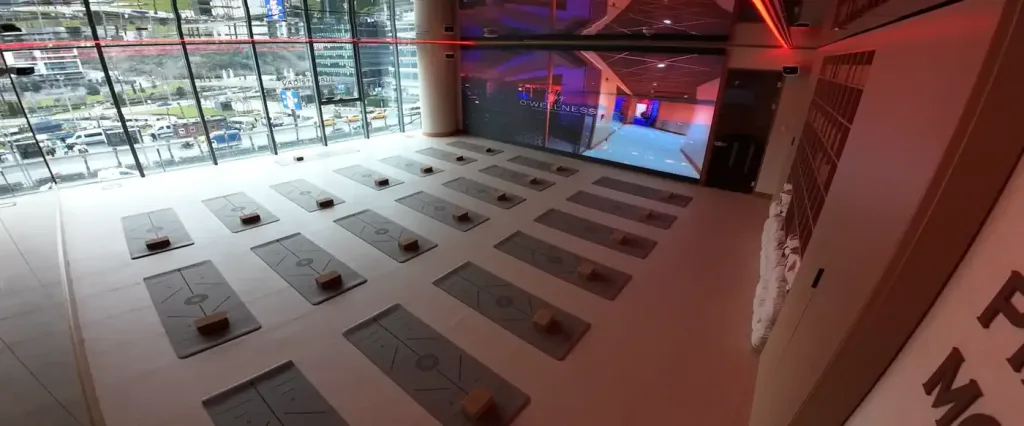
A yoga class in Sarıyer: the weekly schedule at the O’Soul Studio
For anyone looking for a yoga class in Sarıyer, we explain the weekly yoga schedule at O'Wellness Sky's O'Soul Studio, the types of class and details of the facility.

Balance and Proprioception Training: The Skills That Prevent Falls
How do you improve balance? What is proprioception and which exercises develop it? A progressive balance training programme for every age.

A Guide to Yoga Styles: Hatha, Vinyasa, Yin and Choosing the Right One
The differences between hatha, vinyasa, yin, ashtanga and restorative yoga. Which style suits which goal, and what to expect in your first class?
