
Yoga for Men: Breaking the Flexibility Myth
For men, yoga builds not only flexibility but strength, balance and breath control. We look at the common prejudices, the real benefits and practical tips for getting started.
“If yoga isn't about getting your legs behind your ears, what is it?” That question sums up the most common misconception about yoga for men. In fact, yoga is a comprehensive form of training that develops the basic skills many fitness disciplines need: strength, balance, joint control and breath management. In this article we look at why the flexibility myth does not reflect reality, the concrete benefits yoga offers male athletes and general fitness goals, and how to start a programme.
Where does the flexibility myth come from?
In popular media, yoga is usually represented by extremely flexible practitioners in advanced postures, which creates the back-to-front perception that “you have to be flexible already to do yoga”. In reality, yoga classes aim to start from your current range of motion and develop it over time. Someone who arrives with tight hip flexors, short hamstrings or limited shoulder movement may be exactly the person who will benefit most from yoga, precisely in order to address those restrictions.
The restrictions commonly seen in men
- Short hamstrings and hip flexors: Long hours of sitting at work and one-directional movement patterns in weight training can lead to tightness in these areas.
- Limited shoulder and chest movement: Bench-press-heavy programmes can shorten the chest muscles and weaken the upper back, affecting shoulder posture negatively.
- Weak core stabilisation: Visible abdominal muscles and functional core stabilisation are different things; even many strong athletes can have a stabilisation deficit in the deep abdominal and back muscles.
- Restricted ankle and hip rotation: Can make it harder to perform movements such as squats and lunges with full form.
The concrete contributions of yoga to strength training
Most yoga postures require isometric strength and stabilisation. Planks, chaturanga and the warrior series, for example, load the shoulders, core and legs statically and bring into play muscle groups often neglected in weight training. As yoga also develops control to the end of your range of motion, it can improve the quality of your form in movements such as deep squats and overhead presses in weight training. You can find more information about how to plan strength training and mobility work together strength training guide .
Breath control and performance
The diaphragmatic breathing and breath-movement coordination taught in yoga classes are useful not only in the studio but in action too. Being able to control your breath at the right moments while lifting a heavy set or during an intense cardio set affects both performance and safety. Athletes who practise yoga regularly find it easier to internalise managing the breath under control rather than holding it in demanding moments.
Balance and joint health
Postures requiring balance on one leg (such as tree pose and warrior 3) work the small stabilising muscles around the ankle, knee and hip. These muscles are generally not targeted enough in classic weight programmes focused on the major muscle groups and can increase injury risk over time. Regular balance work plays an important complementary role in protecting joint health, particularly in athletes over 35.
Which type of yoga suits men best?
| Type of yoga | The standout feature | Who it suits |
|---|---|---|
| Budokon yoga | Flowing movements influenced by martial arts | Those who enjoy dynamic training |
| Vinyasa yoga | Breath-movement flow, moderate to high tempo | Those wanting to combine cardio and strength |
| Balanced yoga | A balance of strength and flexibility | Those with general fitness goals |
| Deep stretch yoga | Deep stretching with long holds | Recovery after weight training |
| Mobility & stretching | Focused on joint range of motion | Those wanting to improve their squat/deadlift form |
The challenges you may meet in your first class
For an inexperienced male practitioner, the most common difficulty in the first classes is the feeling of not being able to do a posture “fully” in less flexible areas. That is entirely normal, and one of the basic principles of yoga teaching is to adapt the posture to your own body (modification), not the other way round. Asking the trainer for props such as blocks and straps is part of learning properly, not a failure to reach an advanced level.
Step by step: Warrior 2 (virabhadrasana 2)
- Step your feet wide apart, with the front foot facing forward and the back foot turned out to close to 90 degrees.
- Bend the front knee so that it comes over the ankle, without letting it drop inwards.
- Keep the hips open to the sides rather than facing forward and back, and position the torso upright.
- Extend the arms at shoulder height, parallel to the floor, and direct your gaze over the front hand.
- Hold the position for 5-8 breaths, focusing on diaphragmatic breathing.
Modification: Anyone with knee or hip sensitivity can make the front knee angle shallower. For an advanced level, you can hold the position and raise the arms up to move into the “exalted warrior” variation.
Common mistakes
- Taking a competitive approach: Comparing “who is more flexible” with the person next to you or with the trainer reduces your motivation and increases your risk of injury.
- Ignoring the breath: Focusing only on the shape of the movement and not following the rhythm of the breath loses you one of yoga's most important benefits.
- Pushing too hard: Pushing to the point of pain in stretching postures can lead to muscle or ligament injury; a feeling of mild tension is enough.
- Focusing only on stretching and neglecting strength: A balanced yoga practice includes both strength and flexibility; choosing only passive stretching classes limits the benefit.
Who needs to take care?
In conditions such as a herniated disc, a history of serious shoulder injury or uncontrolled high blood pressure, some advanced postures (inversions, deep backbends) should be limited or modified. If you have a health history like this, it is important to consult your doctor and inform your trainer before starting the class.
A 4-week starter plan
| Week | Focus | Frequency |
|---|---|---|
| 1 | Basic postures, breath awareness | 1-2 classes a week |
| 2 | An introduction to balance postures | 2 classes a week |
| 3 | Getting used to flow (vinyasa) paces | 2 classes a week |
| 4 | Combining with weight training | 2 yoga classes a week + your existing strength programme |
How do you measure progress?
Improvements in flexibility usually become noticeable within weeks: the distance from your fingertips to the floor, the depth of your hip angle or how long you can hold a balance posture are all concrete indicators. The real progress, though, shows in the comfort you feel in everyday movements (climbing stairs, bending) and in the quality of your form in weight training. Keeping a log and recording weekly observations helps maintain your motivation.
How do you add it to your existing training programme?
Yoga does not have to replace weight training; the two complement each other. Adding a low-paced class such as deep stretch yoga after heavy training days can support recovery, while a moderate-paced class such as vinyasa yoga can serve as active recovery on rest days. For general recovery strategies, see recovery guide .
The yoga experience for men in Sarıyer
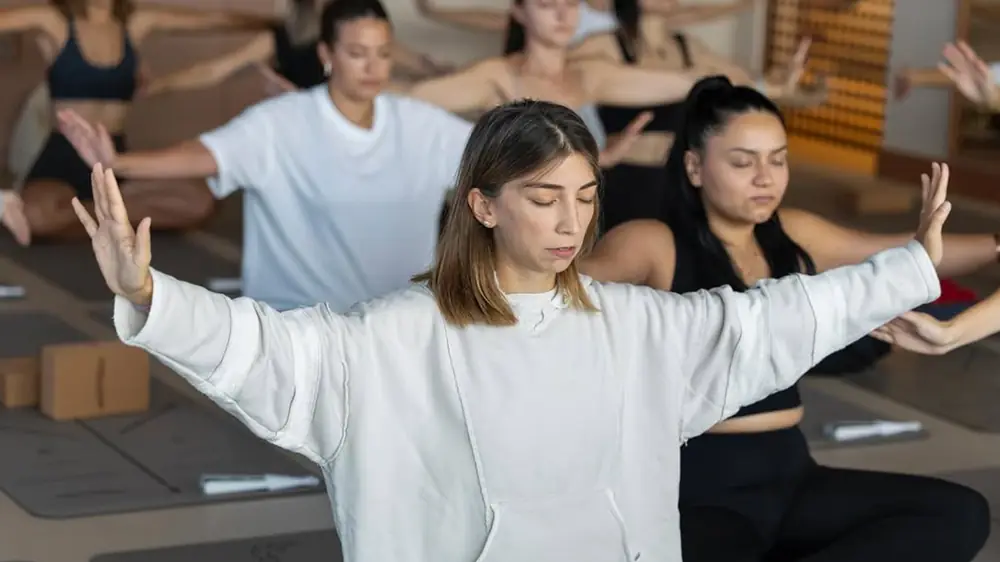
The group classes offered in our O’Soul studio at O’Wellness Sky provide a learning-focused environment free of competition, with a mixed participant profile. Thanks to its position close to the reformer and functional training studios in our 1,800 m² facility in Skyland Istanbul, it is possible to plan both strength and yoga work on the same day.
Using props: blocks, straps and blankets
Yoga props are generally used not for people who are “not flexible enough” but to maintain correct alignment. A yoga block raises the body in postures where the hands cannot reach the floor and lets you keep length in the spine; placing a block under your hands in a standing forward fold (uttanasana), for example, helps keep the back flat rather than rounded. A strap lets anyone with limited shoulder or hamstring flexibility keep their leg or arm position at a safe distance. A blanket is used for support under the knees or hips and reduces pressure on the joint. Using these props is not “failure” but a way of prioritising correct technique.
Mental benefits and stress management
Alongside the physical benefits of yoga, improvements in stress management skills are frequently reported in people who practise regularly. For men with a demanding work schedule, cutting off from their phone and work matters for the duration of a class and focusing only on breath and movement can create a short mental reset. That effect can help ease the physical manifestations of chronic stress (muscle tension, sleep problems) in the long run, but if you are experiencing serious anxiety or burnout symptoms it is important to consult a professional.
Differences in approach by age group
In your 20s and 30s, yoga usually comes in as a complementary layer of flexibility and mobility alongside strength training; this age group generally adapts faster to advanced balance and flow postures. From 40 onwards, yoga takes on a more decisive role in protecting joint health and maintaining spinal mobility; in this period, starting with more controlled, alignment-focused classes rather than fast-paced flow classes reduces injury risk. What both groups have in common is progressing gradually without forcing the body.
The connection between yoga and combat sports
For men interested in or training in combat sports, yoga is a complement that feeds directly into performance, particularly in terms of hip rotation, spinal flexibility and breath control. Martial-arts-influenced forms of yoga such as budokon yoga make that transition more natural, because the movement patterns are partly familiar. For anyone wanting to combine the martial arts work offered one-to-one at O’Wellness Sky with a yoga practice, the two disciplines complement each other naturally.
Frequently asked questions
I'm not flexible at all - can I still do yoga?
Yes - yoga can be adapted to anyone regardless of their flexibility; postures are modified with props such as blocks and straps and set to your current range of motion.
Does yoga make you lose muscle mass?
No - a yoga practice added while you continue regular weight training does not reduce muscle mass; on the contrary, it can support your performance by strengthening the stabilising muscles neglected in strength training.
How many days a week of yoga is enough?
Even 1-2 days a week brings clear benefits when you keep it up; for anyone doing a lot of weight training, timing it for recovery days is a practical approach.
Is there a yoga class in Sarıyer where men will feel comfortable?
Our group classes at O’Wellness Sky in Skyland Istanbul are open to everyone, with a mixed participant profile; more dynamic classes such as budokon yoga offer a familiar pace, especially for those with a weight training background.
Is yoga safe if I have a history of injury?
Generally yes, but if you have a history of shoulder, lower back or knee injury, consulting your doctor and informing your trainer before starting the class means the movements can be modified to suit you.
To try a yoga programme that will complement your strength training, enquiry form fill in the form and we will plan your free trial day.
Related posts

Yoga Props: What Are Blocks, Straps, and Bolsters For?
Blocks, straps, and bolsters exist not to make yoga easier but to fit the pose to your body. We explain how each one is used and in which poses it makes a difference.
Yoga for runners: the hip flexors and hamstrings
Yoga for runners supports performance by increasing hip flexor and hamstring flexibility. We explain which postures to use and when.

Hammock (aerial) yoga: the benefits of inversions, and safety
The benefits of hammock yoga lie in the inversions and spine-lengthening movements performed with the support of fabric suspended from the ceiling. We explain the basic principles, the safety rules and who it suits.
