
Reformer Pilates Levels: What Changes Between Beginner, Intermediate and Advanced?
A comprehensive guide to the differences between reformer Pilates levels in terms of spring resistance, movement speed and the complexity of the repertoire, and when to move up a level.
From their first session, the most common question on a member's mind is generally this: “Which level am I at, and when should I progress?” That is a question almost everyone starting reformer Pilates asks. Reformer Pilates levels are a spectrum along which several variables change together - spring resistance, movement speed, the balance required and the complexity of the repertoire - not a single line. In this article we look in detail at how trunk-arm-leg coordination evolves at beginner, intermediate and advanced level, which criteria determine moving to the next level and how that progression is tracked at O’Wellness Sky.
What determines your level?
Your level in reformer Pilates is not determined by looking only at “how many kilos of spring you pull”. On the contrary, less spring resistance is often used at more advanced levels because controlling the movement becomes harder. The four basic axes that determine the level are:
- The support surface: Progression from supine, fixed-support positions towards standing, single-leg or unsupported balance.
- Movement speed and flow: While at the start every movement is done separately and in a controlled way, at advanced level the movements are linked into an uninterrupted flow.
- The number of joints and complexity: Moving from single-joint movements to multi-joint combinations involving rotation and extension.
- The direction of spring resistance: At advanced level a lighter spring is deliberately chosen in some movements, because control becomes harder.
Beginner level: learning the basic language
The aim of the beginner level is to make the six basic principles of Pilates (centering, control, precision, breath, concentration, flow) concrete on the reformer. At that stage the movements are done supine or seated, using fixed support surfaces.
Typical movements at beginner level
- Footwork: The series of pushing the legs against the footbar while supine; leg alignment and the breathing rhythm become established here.
- The hundred: The basic exercise for core activation and breath coordination.
- Simple strap series: Controlled pulling and extending movements with the arms.
At this stage the trainer concentrates on spinal neutrality, breath timing and basic alignment. On average, the basic movement language is observed to become established at the end of 6-10 sessions, but that period varies from person to person; previous sporting history, level of flexibility and session frequency all directly affect that speed.
Intermediate level: balance and flow come into play
At intermediate level the support surface is reduced; the movements start to be done seated, kneeling or on one leg. The transitions between movements become more fluid and short combinations synchronised with the breath are learned.
Typical movements at intermediate level
- The short box series: Trunk flexion, extension and rotation done seated.
- The kneeling arm series: Arm movements in a kneeling position with the core stable.
- Long stretch: Core and shoulder girdle endurance by pushing the platform in a plank position.
- Single-leg footwork and bridge variations: Unilateral stability and work on asymmetry.
The general criterion for moving to this level is being able to complete the beginner movements with correct alignment, without holding the breath and without the platform wobbling. The trainer makes that assessment by observing during the session; there is no fixed rule on a number of sessions.
Advanced level: complex combinations and minimum support
At advanced level the movements involve unsupported balance, single-leg and single-arm combinations and fast transitions. The spring resistance is generally reduced because control becomes harder; some standing balance movements, for example, are done with the lightest spring.
Typical movements at advanced level
- Combinations of the elephant and stomach massage series: They combine hip and spinal mobility in a way requiring high control.
- Standing balance movements on the platform: Whole-body stability with minimum support.
- Flowing repertoire sequences: Several movements linked without a break through the breath.
A comparison between the levels
| Criterion | How it starts | Intermediate | Advanced |
|---|---|---|---|
| The support surface | Supine, seated | Kneeling, single leg | Standing, unsupported balance |
| Movement speed | Slow, separate | Moderate, partly fluid | Fast, uninterrupted flow |
| Spring resistance | Moderate to heavy (for support) | Variable | In keeping with the movement, sometimes light |
| Focus | Alignment, breath | Balance, coordination | Flow, complex control |
The effect of age and past sporting experience
The speed of progression between levels depends not only on Pilates experience but also on a person's general movement history. Members with a background in dance, swimming or yoga generally start with an advantage in terms of body awareness and balance, which can speed up the move to intermediate level. By contrast, in members who have been inactive for a long time or have a history of chronic pain, staying at the basic level for longer is necessary for safe and sustainable progress. In members over 50, too, the pace of progression differs individually; age alone is not a limitation, and what matters is joint health and muscular strength. The trainer learning that history in the first conversation helps set the pace of the programme correctly.
Does a group class or one to one make a difference in terms of level?
Because the levels are predetermined in group classes (beginner, intermediate, advanced), a member progresses alongside their peers by joining the class suited to their level. In one-to-one sessions, meanwhile, the programme is designed entirely around the individual and level transitions can be adjusted more flexibly, in the moment, according to the member's capacity on the day. For beginners, starting with a one-to-one format and moving on to group classes once the basic movement language is established can be both a safe and a socially satisfying route.
Common mistakes when moving up a level
- Moving up too early: Moving on to advanced movements before basic alignment is established reinforces compensation patterns.
- Misinterpreting the spring: Thinking “a heavy spring = advanced level”; in fact some advanced movements are harder with a light spring.
- Comparison: Comparing your level with that of the person on the next machine; progress is individual, and body structure and past sporting experience affect how long it takes.
An example case
The progression of a member with no previous Pilates experience who works at a desk generally goes as follows: in the first 4-6 sessions, basic alignment and the breathing rhythm are worked on with footwork, the hundred and simple strap series. At that stage the trainer focuses on spinal neutrality and the platform moving without wobbling. Around the 8th-10th session, when the basic movements have become controlled, the short box series and kneeling arm movements are added to the programme. From the third month, when balance and coordination are considered sufficient, single-leg footwork and bridge variations come into play. This is not a fixed timetable but an observational example; for some members the process can be faster and for others longer.
Equipment and technical details
As the level progresses, the pieces of equipment used also become more varied. While mainly the footbar and shoulder supports are used at the start, at intermediate level the straps and the short box come into play more often. At advanced level, movements done standing on the platform are performed without balance support; at that point the colour of the spring (which indicates the resistance level) is chosen deliberately according to the purpose of the movement. In a balance movement the lightest spring may be preferred, for example, while in a power movement a moderate to heavy spring may be used. The trainer explaining their choice of spring means the member comes to recognise the right resistance for their own body over time.
Which level is not suitable for whom?
Members with balance problems, dizziness or serious joint instability should not move on to advanced unsupported balance movements before they are ready; in those situations it is safer to progress with supported variations. Members experiencing acute back or neck pain, meanwhile, are advised to avoid the movements that trigger the pain regardless of level and to get a doctor's approval. During pregnancy, progression between levels should be paused and work continued with modifications suited to the current capacity.
How is progress measured?
In transitions between levels, trainers generally observe the following indicators:
- Platform control: The platform moving quietly, without jolting, during the movement.
- Breath-movement synchronisation: The breath continuing in keeping with the movement, without interruption.
- Consistency of alignment: Spinal and joint alignment being maintained without breaking down across repetitions of the same movement.
- Fluidity of transitions: Being able to continue without pausing in the transitions between movements.
These indicators are not an objective examination but rest on the trainer's observation during the session; regular attendance and working with the same trainer therefore provide an advantage for accurate level assessment. We recommend that our members get brief feedback after a session and note which movements felt hard and which felt comfortable; that simple habit contributes directly to the trainer's planning of the next session.
Combining it with other classes
Whatever your level, it is useful to support reformer Pilates with complementary classes. For members at beginner level we recommend, which builds general mobility, and for intermediate and advanced level Mat Pilates, which supports balance and breath control. Vinyasa Yoga Members wanting general strength development can balance their programme with the Total Body class.
How do you know your level?
At O’Wellness Sky the group classes are programmed by level; our recommendation for new members is to spend the first few sessions as an assessment session in a one-to-one or small group format. By observing your alignment, breath control and balance capacity, the trainer will recommend the level suited to you. Transitions between levels should be safe and gradual rather than forced; pain or a feeling of excessive strain is a sign to step back a level.
Levels at the O’Wellness Sky Reformer Studio
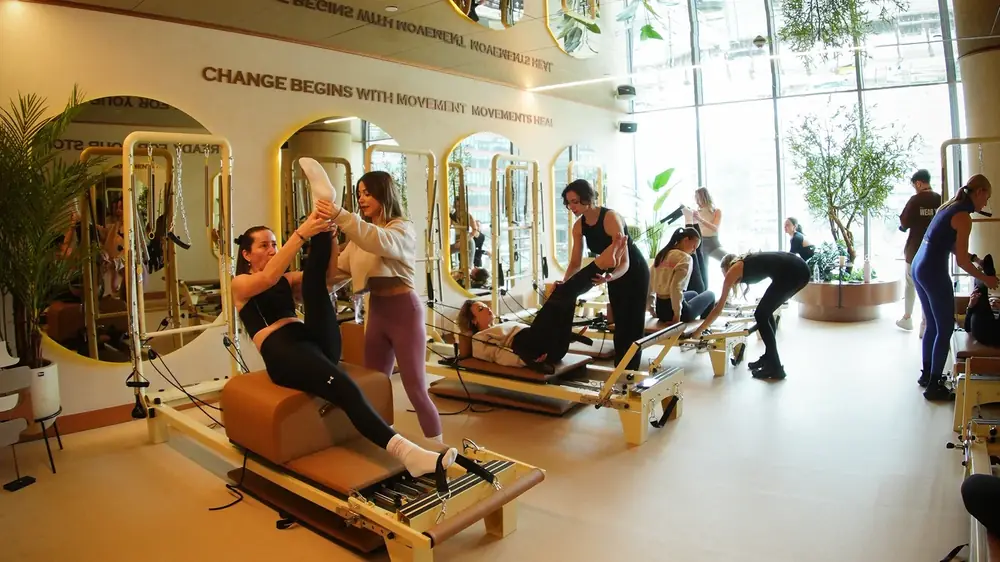
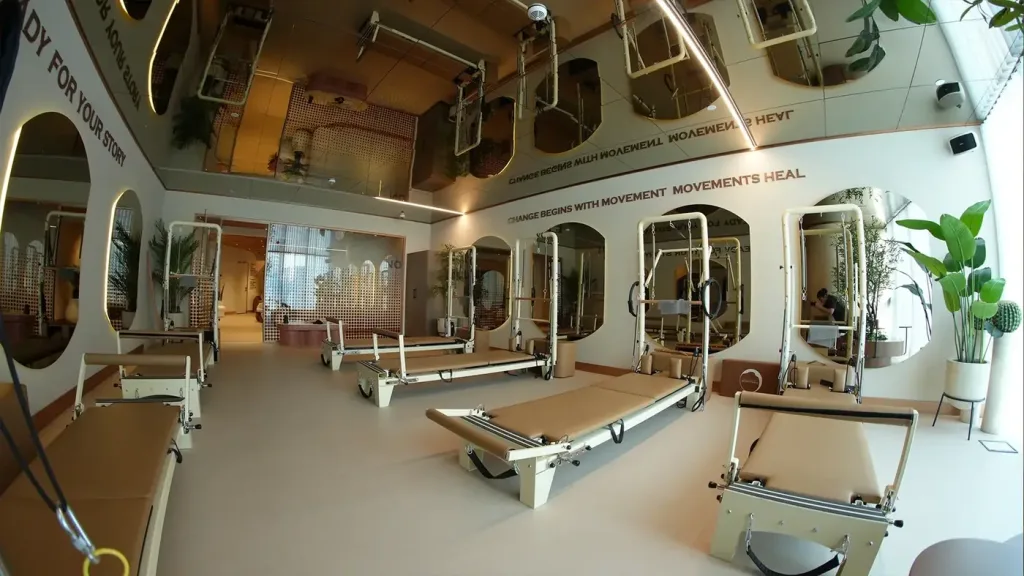
In our Reformer Pilates Our studio has 8 Balanced Body reformers and sessions are run with a maximum of 6-8 people, which means the trainer can offer modifications suited to each participant's level in the moment. A one-to-one assessment session is recommended for beginners and group classes for intermediate and advanced levels; where needed, the programme can be sped up or deepened with one-to-one sessions at any level. You can find the basic building blocks of reformer Pilates in our What Is Reformer Pilates? guide and the terms in our glossary article. For general strength development you can support your reformer programme with the Total Body you can support your reformer programme with the class.
Frequently asked questions
How long does it take to go from beginner to intermediate level?
It varies from person to person; with regular attendance, comfort and correct alignment in the basic movements generally become established within a few months. Your trainer assesses that transition during sessions.
Is less spring used at advanced level?
In some movements, yes. As the difficulty of control and balance increases at advanced level, a lighter spring may be deliberately chosen; that is not a step back but a different kind of difficulty.
Do I have to move up a level?
No. Many members prefer to stay at beginner or intermediate level and that is entirely normal; the aim is not to move up a level but to move safely and effectively. What matters is being able to do the movements correctly and under control at your current level.
Can I find a reformer class suited to my level in Sarıyer?
Yes. O’Wellness Sky has group classes suited to beginner, intermediate and advanced level as well as one-to-one options; Skyland Istanbul offers easy access along the Maslak-Sarıyer line.
To determine your level, enquiry form fill in the form and make use of our free assessment session.
Related posts
Reformer Pilates in Pregnancy: A Guide to Safe Practice by Trimester
Reformer Pilates in pregnancy can be practised safely in all three trimesters with the right modifications. We explain the choice of movements by trimester, what to avoid and tips for getting ready.

Does Reformer Pilates Help You Lose Weight? The Facts About Calories, Muscle Mass and Body Composition
A realistic answer to the question of whether reformer Pilates helps you lose weight, looking at calorie burn, muscle mass, metabolism and body composition, plus recommended combinations for weight management.
Ten criteria to consider when choosing a reformer pilates studio in Sarıyer
When looking for a reformer pilates studio in Sarıyer, review 10 critical criteria — the number of machines, group size, trainer certification and more — in a comparison table.
